
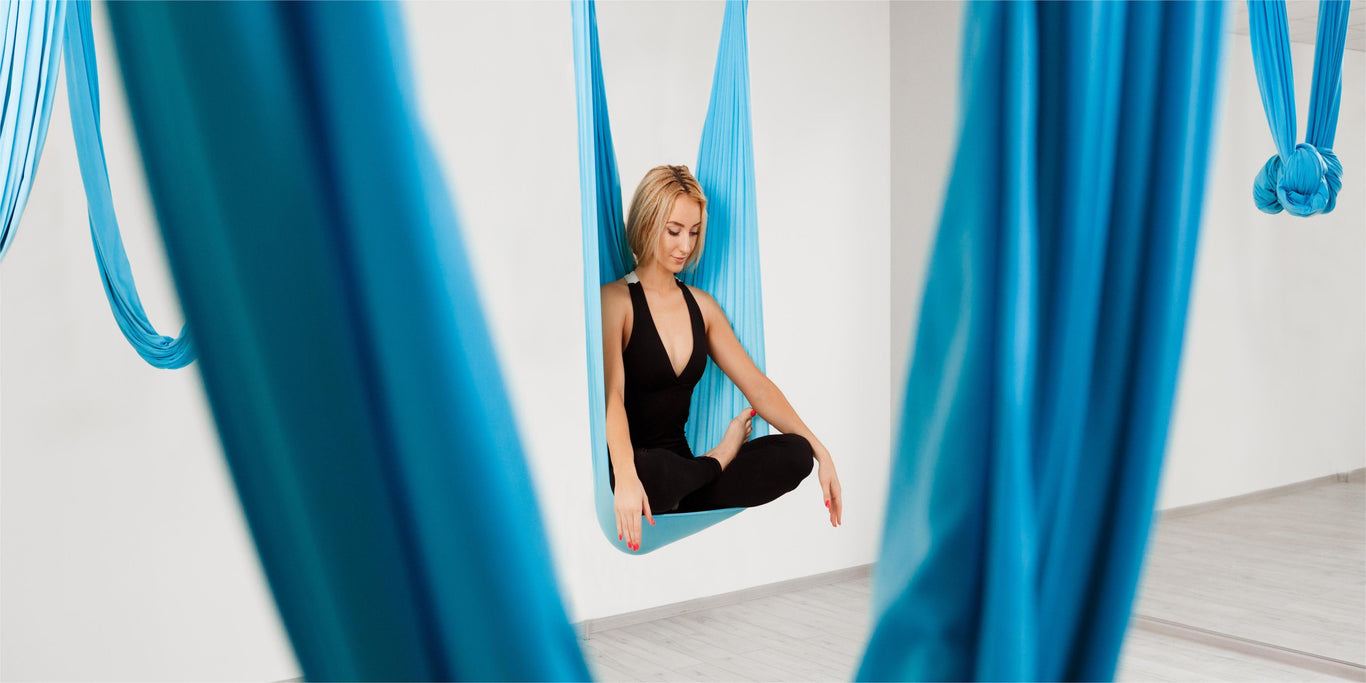
Yoga Trapeze Swing


A yoga swing gives you a different way to explore movement away from the floor. The fabric hangs like a hammock and can be sat in, held, or wrapped around the body. It can be used for twists, folds, backbends and other aerial yoga movements.
Our swings are made from parachute-style fabric and include padded handles on both sides. These give you several places to hold while getting into position or moving between exercises. The exact setup can differ from one swing to another.
Using a Yoga Swing
Aerial yoga feels quite different from working on a mat. The fabric moves with you, and even familiar positions can take a little time to get used to.
Some movements are done while sitting or lying in the hammock. Others use the handles or straps while the fabric supports part of the body. It is best to begin with simple positions and learn how the swing moves before attempting anything more complicated.
Inversions and advanced movements should be learned with proper guidance. Do not rush into them simply because the swing feels secure.
Before each use, check the fabric, stitching, handles, straps and connection points. Nothing should be loose, frayed or damaged. The swing must also be attached to a suitable fixing point that can safely support the equipment and the person using it.
Follow the installation instructions and stated weight limit supplied with the product. A ceiling hook, beam or doorway fitting should never be used unless it has been properly checked and confirmed as suitable.
Choosing a Yoga Swing
Not every yoga swing comes as a complete kit, so have a close look at what is included before ordering.
Some sets come with the main fabric, extension straps, padded handles and attachment hardware. Others may include only the swing and straps, leaving you to purchase certain fittings separately.
The length of the fabric is worth checking, as is the number and position of the handles. Some swings have several handles at different heights, while simpler designs may have fewer adjustment points.
You will also need to think about the space where it will hang. The floor beneath it should be clear as well.
Comfort and Practical Use
Take a moment to straighten the fabric and straps before you begin. Twisted straps or bunched fabric can make the swing feel awkward and may place pressure on the wrong parts of the setup.
Some people place a yoga mat underneath the swing. This gives the area a clear boundary and provides a more comfortable surface when moving between the floor and the hammock.
Hanging height is another personal choice. A lower setup may feel easier to approach, while a higher position may be used for different movements. Any adjustment should still remain within the instructions supplied with the swing.
Cleaning instructions vary, particularly where metal fittings, padded handles or different fabric types are involved. Check the individual care guidance before washing or using cleaning products.
Browse the collection to compare the colours, fabric lengths, handle arrangements and fittings included with each yoga swing.
Understanding the Handles
Many yoga swings have several padded handles hanging at different heights. These give you a choice of places to hold as you move in and out of the hammock.
The number of handles can differ between swings. Some have one pair on each side, while others have several handles attached along longer straps. The handles may also vary in size, shape and padding.
Have a close look at how they are connected. On some swings, the handles form part of the strap system. On others, they may be attached separately or moved between different loops.
Padding can make the handles more comfortable to hold, but it should still be checked regularly. Do not continue using a handle if the covering has split, the stitching has come loose or the inner section feels damaged.
Yoga Swing, Hammock or Trapeze?
A yoga hammock may refer mainly to the large piece of fabric. Some hammock-style products do not have padded handles at all.
A yoga swing often includes both the fabric sling and a set of handles. A yoga trapeze usually has several handles attached at different heights, although product names are not always used consistently between manufacturers.
Aerial silks are different again. These are usually long lengths of fabric without the same hammock shape or handle system.
The photographs and list of included parts will usually tell you more than the product name by itself.
Preparing the Swing Before Each Use
A quick check before every session can help you notice damage before it becomes worse. Open the fabric and look along both sides.
Check for small tears, thinning areas or loose threads. Pay particular attention to places where the fabric joins the straps or gathers around fittings.
Look over the stitching on the handles and extension straps. Carabiners should close properly and should not be bent, cracked or difficult to operate.
Using a Mat Underneath
Some people place a yoga mat beneath the swing. This creates a clear area underneath and gives you a softer surface when moving between the hammock and the floor.
The mat should lie flat without curled edges. Make sure it does not cover fittings or create a trip hazard close to the straps. A thick mat may change how easily your feet move across the floor, while a smooth mat may shift on certain surfaces.