
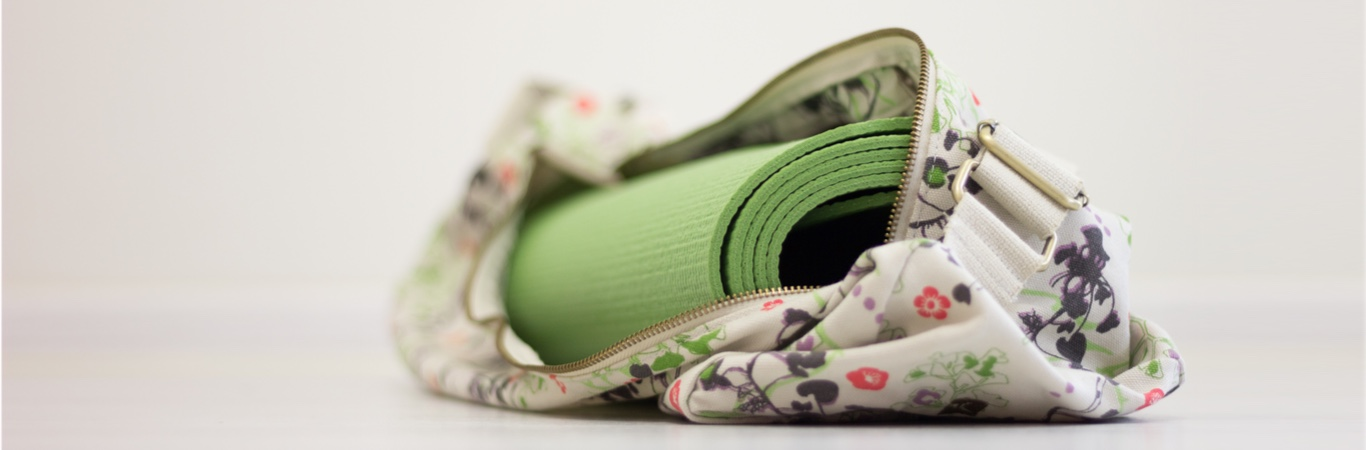
Yoga Mat Bag


Choosing a Yoga Mat Bag
A yoga mat is easy enough to carry on its own. It becomes more awkward when you also have a towel, water bottle, change of clothes and the rest of your things to take with you.
There are a few ways to carry a mat. Some bags cover the whole roll and may have room for a few extras. Slings and simple straps leave the mat uncovered but are usually lighter and take up less space. Check the measurements and photographs before ordering, as a thick mat may not fit every bag.
Yoga Mat Bag, Sling or Carrying Strap?
A yoga mat bag normally covers most or all of the rolled mat. It may close with a zip or drawstring and often has a shoulder strap for carrying.
A mat sling is more open. It usually has loops at each end that wrap around the rolled mat, leaving much of it uncovered. Some slings can also be used as stretching straps, although this depends on the individual product.
A basic carrier strap is the simplest option. It holds the mat together but does not have an enclosed compartment for clothes or other belongings.
Look closely at the photographs and product description so you know which type you are ordering. A strap shown around a mat is not necessarily a bag.
Will Your Mat Fit?
A standard bag may fit a thin mat but be too narrow for a thicker one.
Check the length of the bag as well as the width of its opening. The rolled diameter of the mat is particularly important when choosing a zipped or drawstring design.
A bag can be long enough for the mat but still too narrow around the middle. Thick mats, extra-wide mats and large exercise mats may need a roomier carrier.
When the measurements of the rolled mat are not listed, measure it at home before ordering a separate bag.
Different Bag Styles
Some yoga mat bags have a long, narrow shape made mainly for carrying one rolled mat.
A tote-style bag may have two shorter handles and an open or zipped top. Backpack designs usually have shoulder straps and may carry the mat vertically or across the outside.
There are also bags with the mat held beneath straps on the outside.
Fastenings and Openings
A full-length zip gives a wide opening and makes it easier to place the mat inside. Check that the zip runs far enough along the bag, especially when the mat is thick.
Drawstring bags are opened from one end. They are straightforward to use, although the opening still needs to be wide enough for the rolled mat.
Some designs have an open top with straps holding the mat in place.
Pockets and Extra Space
Not every yoga mat bag has room for more than the mat.
Some include a small zipped pocket for keys, a phone or other little items. Larger bags may have space for clothing, a towel or a water bottle, but this should not be assumed from the photographs.
A narrow outer pocket may be useful for flat belongings but may not hold a large bottle or rolled towel.
Try not to overfill the bag. Putting too much inside can place extra pressure on the zip, seams and shoulder strap.
Shoulder Straps and Handles
Many bags have one long shoulder strap.
An adjustable strap gives you more choice over where the bag sits when carried.
Tote bags may have two shorter handles instead. Backpack designs can have two straps, and some mat bags include both a shoulder strap and a small grab handle.
The photographs should show how the straps are attached. Stitching around these points is worth checking from time to time, particularly when the bag is used regularly.
Materials and Weight
Yoga mat bags are made from a variety of materials, including cotton-style fabrics, canvas, polyester and other woven materials.
A lightweight bag is easier to carry, but the overall weight will also depend on the mat and anything else placed inside. A large bag may feel quite different once it contains a thick mat, clothes and a water bottle.
Some fabrics are soft and fold down when the bag is empty. Others have a more structured shape.
Read the individual listing for confirmed material details.
Before Ordering
Check the following details before choosing a yoga mat bag:
The full length and width of the bag
The size of the opening
The rolled size of your yoga mat
Whether the mat sits inside or outside the bag
The type of fastening
The number and size of the pockets
Whether the shoulder strap is adjustable
The listed material and care instructions
What is included with the product
Measuring a Rolled Yoga Mat
Before buying a bag, roll your mat in the same way you normally would after class. There is not much point measuring it loosely if you usually roll it tightly, as the finished size may be quite different.
Start with the full length of the roll. This tells you whether the bag will be long enough for the mat to sit inside without the ends being forced against the zip or drawstring.
Next, measure across the round end of the mat. This is the diameter of the roll and is often the measurement people forget. A bag can be long enough but still be too narrow for a thick mat.
It may also help to measure around the middle of the rolled mat. This is particularly useful when choosing a sling or carrier strap, as the loops need to open wide enough to fit around the roll.
Write the measurements down before comparing bags. Product photographs are useful, but they rarely show how wide the opening is or how much room is left once the mat is inside.
Travelling on Public Transport
A long yoga mat bag can feel quite different on a busy bus or train than it does during a short walk.
Keep the bag close to your side so that the ends do not knock into seats, doors or other passengers. A cross-body strap may help with this, although it depends on the length of the bag and the way the strap is attached.
Loose straps should not be left trailing. Shorten adjustable sections where possible and check that buckles are secure before travelling.
Looking at the Base
The base of the bag takes much of the weight once the mat is placed inside.
Some bags have a round end that follows the shape of the rolled mat. Others have a flatter panel or a reinforced section around the bottom.
A simple fabric base may fold when the bag is empty. A structured base is more likely to hold its shape, although it may make the bag slightly bulkier.
Look at the stitching around the base where close-up photographs are available. This is one of the areas most likely to rub against floors, car boots or studio surfaces.
Try not to drag the bag along the ground. Even a thick fabric can begin to wear when the same area is repeatedly scraped.
Zip Position and Opening Size
Some yoga mat bags have a zip running almost the full length of the side. Others open only at one end.
A long side zip usually gives you more room to place the mat inside. The bag can be opened out rather than requiring the roll to be pushed through a narrow opening.
End-opening bags are simpler in shape, but the opening still needs to be wide enough for the mat. This is particularly important with thicker designs.
Some zips have two pullers, allowing the bag to be opened from either direction. Others use one. A small flap may cover the zip on certain designs.
Check that the zip is not being pulled tightly around the mat once the bag is packed. Repeatedly forcing the fastening can affect both the zip and the surrounding fabric.
Drawstring Bags
A drawstring yoga mat bag is normally loaded from one end.
The opening should spread wide enough for the rolled mat to pass through without the fabric being pulled too tightly. Once the mat is inside, the cord can be drawn closed around the end.
Some bags use a plastic or metal cord lock. Others need to be tied by hand. A cord lock is convenient, although it should still move freely and hold its position properly.
Loose cords can catch around other equipment, so gather or tuck them away before carrying the bag.
The drawstring area is worth checking over time. Fabric around the cord channel may begin to wear if the bag is regularly overfilled or pulled shut too firmly.
Using the Bag for Storage at Home
A yoga mat bag can also keep the rolled mat together when it is not being taken to class.
Make sure the mat is dry before leaving it inside. The bag should be stored somewhere dry as well, rather than against a damp wall or on a cold floor.
Colours and Patterns
Yoga mat bags come in plain colours, printed fabrics and mixed designs with contrasting straps or panels. A large pattern may look different once the bag is filled with a rolled mat. Sections shown clearly on a flat product photograph may curve around the sides when the bag is packed.
Dark colours can show pale fluff or dust, while light fabrics may make marks from floors and public transport more visible. Printed designs may vary slightly depending on where the fabric has been cut.