
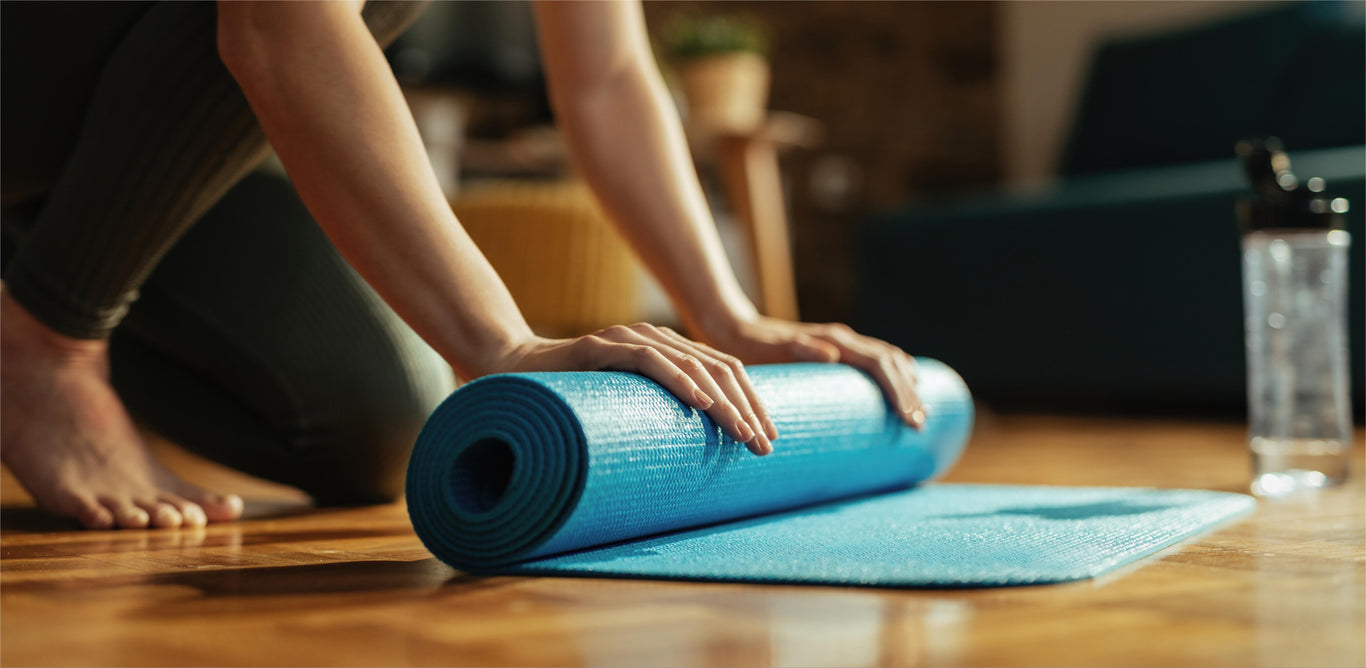
Yoga Mat


Buying a yoga mat sounds simple until you start comparing them.
Our collection includes plain and patterned mats in several colours, thicknesses and materials. Some roll up tightly and are easy to take to class. Others are heavier and better suited to staying at home.
Thick or Thin Yoga Mat?
A thick mat puts more material between you and the floor. It will normally be heavier and create a larger roll when packed away.
A thinner mat takes up less space and is often easier to carry. This can be useful when you travel to classes. Keep your equipment in a small cupboard or fit the mat into a larger bag.
No thickness suits everybody. Some people like a substantial mat and others would rather have something lighter and less bulky.
Looking at the Surface
The top of a yoga mat may be smooth or finely textured.
Do not forget to look at the underside. It may be made from a different material or have a separate pattern from the top. The main product photograph does not always show this clearly, so scroll through the full gallery before choosing.
A new mat can also feel different once it has been unrolled and used several times. Check the care details supplied with the individual product and keep an eye on the edges and surface as the mat gets older.
Different Materials
Our range includes cork mats alongside mats made from several types of foam and rubber-based material. The exact construction differs from one product to another.
A cork mat will usually have a cork layer on top and a different material underneath. Other mats may be made from one material throughout or built from separate layers.
Do not assume that two mats made from similar materials will feel or weigh the same.
The individual product page is the best place to check what a particular mat is made from. It should also tell you whether any strap, bag or other extra is included.
Taking a Mat to Class
Think about the journey as well as the class itself.
A large mat may be easy enough to carry from one room to another but less convenient on public transport. Check how tightly it rolls and whether a carrying strap is supplied.
Some people are happy to carry a mat under one arm. Others prefer a sling or a proper mat bag, particularly when they also have clothing, water and other equipment to bring along.
Travel mats are usually thinner and easier to pack, although the exact weight and rolled size still vary. It is worth measuring the space inside your bag or car boot rather than assuming the mat will fit.
Using a Mat at Home
A mat that stays at home does not need to be as portable, but storage can still become an issue.
Longer and thicker mats can take up more room than expected.
A round mat roll can move about on a hard floor, so it may need to be placed against a wall or between other pieces of equipment.
Cleaning and General Care
Different surfaces need different care, so always check the instructions for the particular mat.
A lightly damp cloth may be enough for some mats. Others may have a surface that should not be soaked or cleaned with strong sprays. Cork, printed finishes and layered mats may each need slightly different treatment.
What to Check Before Ordering
Have a look at the following details before making a decision:
The full length and width
The stated thickness
The product weight
The top and underside surfaces
The materials used
The rolled size
Whether a strap or bag is included
The cleaning instructions
The space available for storage
Choosing the Right Length and Width
Yoga mats are not all made to the same measurements. Some are a little longer than standard, while others give you extra room across the width.
Taller customers may prefer to check the full length before ordering. It is better to use the measurements shown on the product page rather than assuming the mat will be a standard size. Width is worth checking too.
A wider mat provides a larger floor area, but it also forms a longer roll and may not fit inside every carrying bag. Think about where the mat will normally be used. A large mat may fit easily into a spare room at home but feel awkward in a busy class where mats are placed close together.
Checking the Rolled Size
The measurements of a flat mat do not tell you how bulky it will be once rolled. Thick mats usually create a wider roll, even when the length and width are fairly ordinary.
What Comes With the Mat?
Some yoga mats are supplied on their own. Others include a carrying strap, sling or storage bag.
Do not assume that every object shown in the photographs is included. A strap, block or towel may have been added to the picture simply to show the mat in use.
The product description should list what comes in the package. Check this before ordering, especially when a carrier is important to you.
A basic carrying strap normally loops around both ends of the rolled mat. A full mat bag covers more of it and may have a zip, drawstring or shoulder strap.
The two are quite different, so look closely at the wording. A product described as including a strap will not necessarily arrive with an enclosed bag.
Plain, Printed and Marked Mats
A plain yoga mat usually has one colour across most of the surface. Some have a slight pattern in the material, while others are completely simple.
Printed mats can include floral designs, geometric patterns, symbols or contrasting colours. The design may cover the whole mat or appear only in one section.
Some mats also have lines or markings running along the surface. These may be printed on top or formed as part of the texture.
Look through the full image gallery when choosing a patterned mat. The design may look very different when the mat is completely unrolled compared with the smaller main photograph.
Printed areas may also need slightly different care. Strong cleaning sprays or rough cloths could affect certain finishes, so follow the instructions supplied with the individual mat.
Which Side Faces Up?
Some mats have an obvious top and bottom. Others look quite similar on both sides.
The upper side may have a printed design, cork layer or finer surface texture. The underside may use a different pattern or material.
Look at the product photographs and description before using the mat. Side-view images are often helpful because they show how the layers are arranged.
Do not assume that the brightest or smoothest side must always face upwards. The intended position will depend on the way the particular mat has been made.
When both sides are designed to be used, the product page should say so. Otherwise, follow the supplied instructions.
Carrying Straps and Mat Bags
A carrying strap is the simplest option for moving a rolled mat. Check whether the loops can open wide enough for a thick mat. A mat bag encloses the mat more fully. It may have a zip along the side, a drawstring at one end or a separate pocket for smaller belongings. Bag sizes vary, and a large or thick mat may not fit inside a standard design. Measure the rolled mat before buying a carrier separately. It is also worth checking the bag’s length. A mat may fit around the middle but still be too long for the zip or drawstring to close.
Before Ordering
Check the full length and width of the mat, not just the name or main photograph. Look at the thickness, weight and materials. Think about where the mat will be stored and whether it needs to be carried regularly. Check whether a strap or bag is included. When buying a carrier separately, compare its measurements with the size of the rolled mat.